
Overview
Origin and history
The tradition belongs to the mud-built cities of Hausaland and their masons' guilds, whose reputation for vaulted and decorated building is long established and was carried further under the Sokoto Caliphate and the emirates. Zaria and Kano are especially associated with elaborate facade work, and named master builders are remembered in both. Cement render and concrete block have replaced much traditional earth building since the mid-twentieth century, and decorated earth facades are now maintained mainly on palaces, older compounds and restored buildings.
Materials and techniques
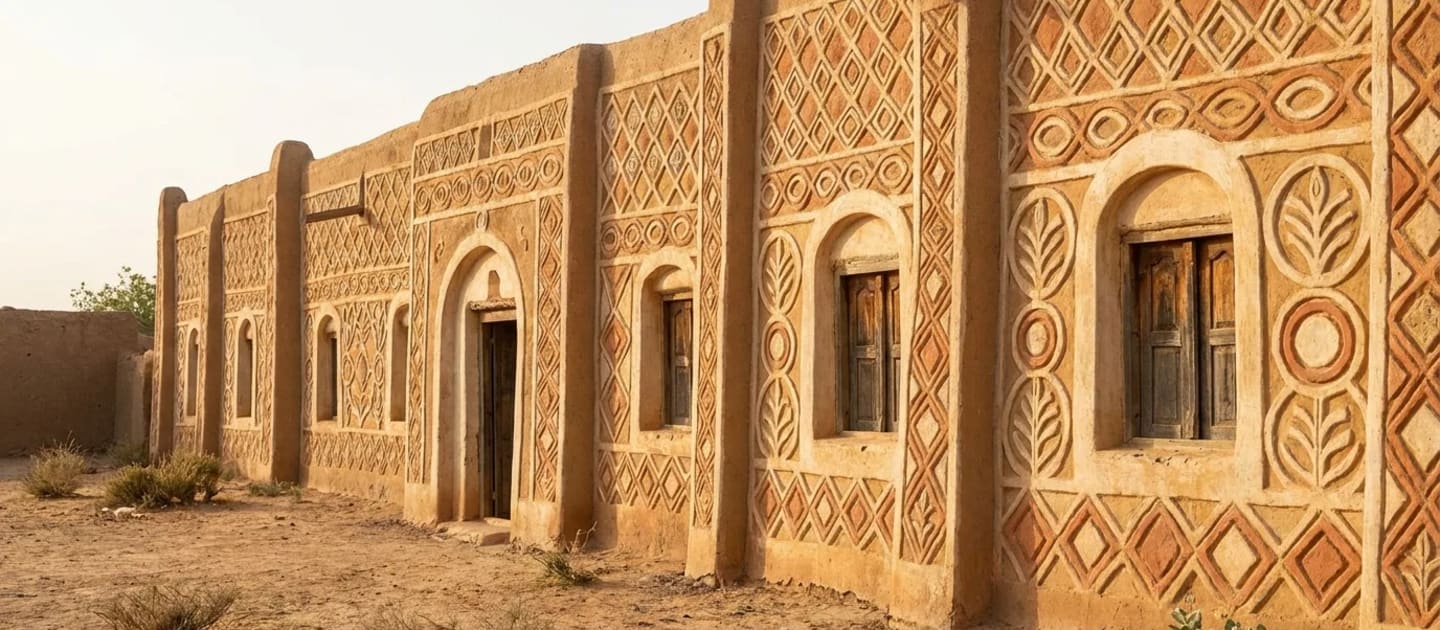
Walls are built of sun-dried earth bricks and rendered with a mud plaster, sometimes stabilised with additives to resist rain. Decoration is worked into the render as raised relief while it is still soft, or built up and cut back, producing interlacing bands, panels, chevrons and roundels; surfaces are then washed with earth colours, and pinnacles and parapets finish the roofline. Interiors use the same relief on walls and around the arched earth ribs that span larger rooms.
Cultural significance
A decorated facade marked the status of the household or office behind it, and elaborate work was concentrated on palaces, the houses of title-holders and merchants, and the gates of walled cities. The masons who did the work held recognised standing, and their designs became part of the identity of particular cities. The relief vocabulary also carries into modern Nigerian public architecture in the north, where the motifs appear rendered in cement.
Notable examples
Zaria facade relief
Interlaced and panelled relief work on compound and palace facades in Zaria.
Emir's palace interiors
Relief decoration around the arched earth ribs spanning large palace rooms.
City gate ornament
Moulded relief and parapet work on the gates of walled Hausa cities.
Connected history and culture
The cities and courts this work served are covered on the Kano Emirate and Sokoto Caliphate pages, within the wider account of pre-colonial Nigeria.