
Overview
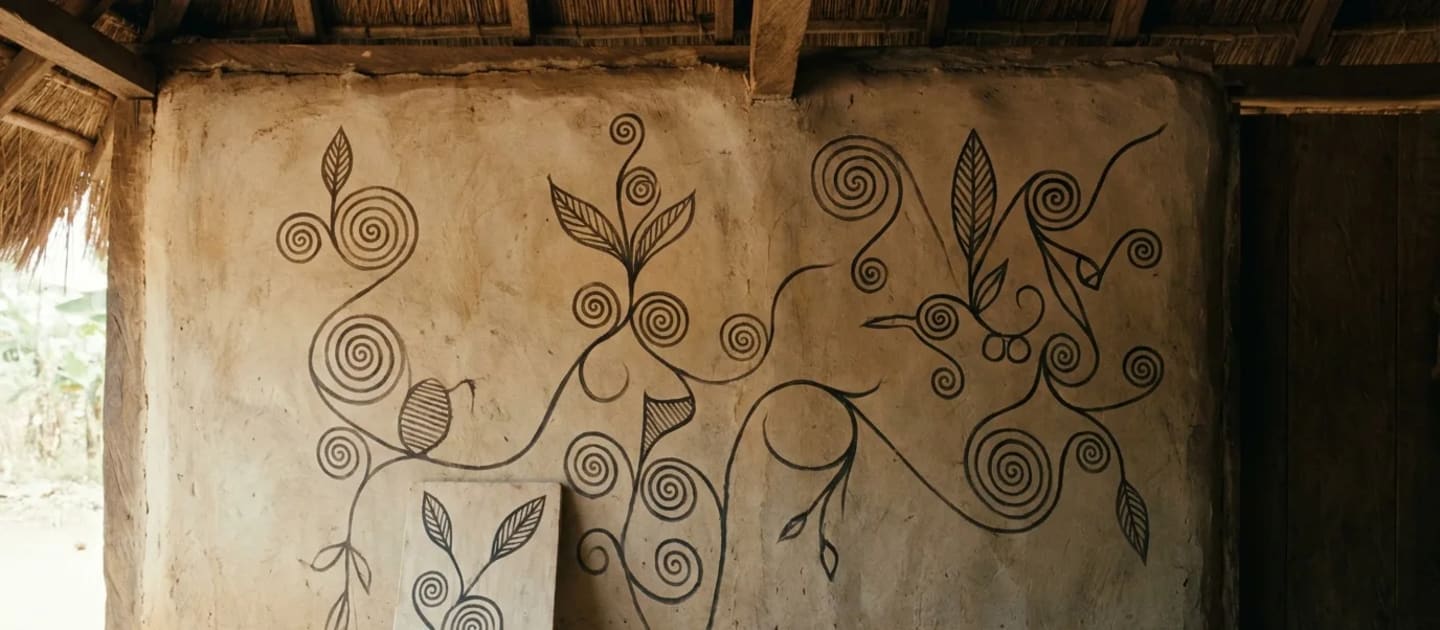
Uli is the drawing and painting tradition of Igbo women, applied to the body in dark plant dye and to house and shrine walls in earth pigments. Its line is flowing and asymmetrical, and it was made to be seen for a season rather than kept.
Origin and history
Uli is recorded across Igbo-speaking areas of the south-east, including Anambra, Enugu and Abia states, and was practised by women who built reputations as designers. Body painting was tied to markets, festivals, title ceremonies and marriage, while wall painting was done for compounds and shrines and renewed periodically. Its everyday practice declined through the twentieth century with changes in dress, building materials and religion. From the 1960s and 1970s artists and teachers associated with the University of Nigeria, Nsukka, took uli line as the basis for a modern painting and drawing idiom, which is why the tradition is now as visible in galleries as in compounds.
Materials and techniques
Body designs were drawn with a thin stick or feather using juice from the uli plant, which dries dark over hours and fades within one to two weeks. Wall designs used lime, kaolin, charcoal and coloured earths, applied with cloth, feathers and fingers over a prepared surface. Designs were composed freehand and directly, without sketching, and motifs were drawn from plants, animals, household objects and abstract patterns, arranged so that no two areas are quite symmetrical.
Cultural significance
Uli was decoration and also social language: patterns signalled occasion, status and taste, and a well-drawn woman was a credit to the designer. Because the work was deliberately impermanent, its value lay in the drawing and the occasion rather than in the object, which sets it apart from traditions made for keeping. Its later adoption as the basis of the Nsukka school made it one of the main routes by which an indigenous visual language entered modern Nigerian art.
Notable examples
Body designs
Freehand drawing in uli plant dye, applied for markets, festivals and ceremonies and fading within weeks.
Compound wall painting
Earth-pigment designs on house and shrine walls, renewed periodically.
Nsukka school painting
Modern Nigerian painting and drawing built on uli line, developed from the 1960s at Nsukka.
Connected history and culture
The tradition sits alongside the Igbo ceremonial cloth described on the Akwete cloth weaving page, and the title and festival occasions it marked are covered under traditional institutions.