
The compound and the lineage
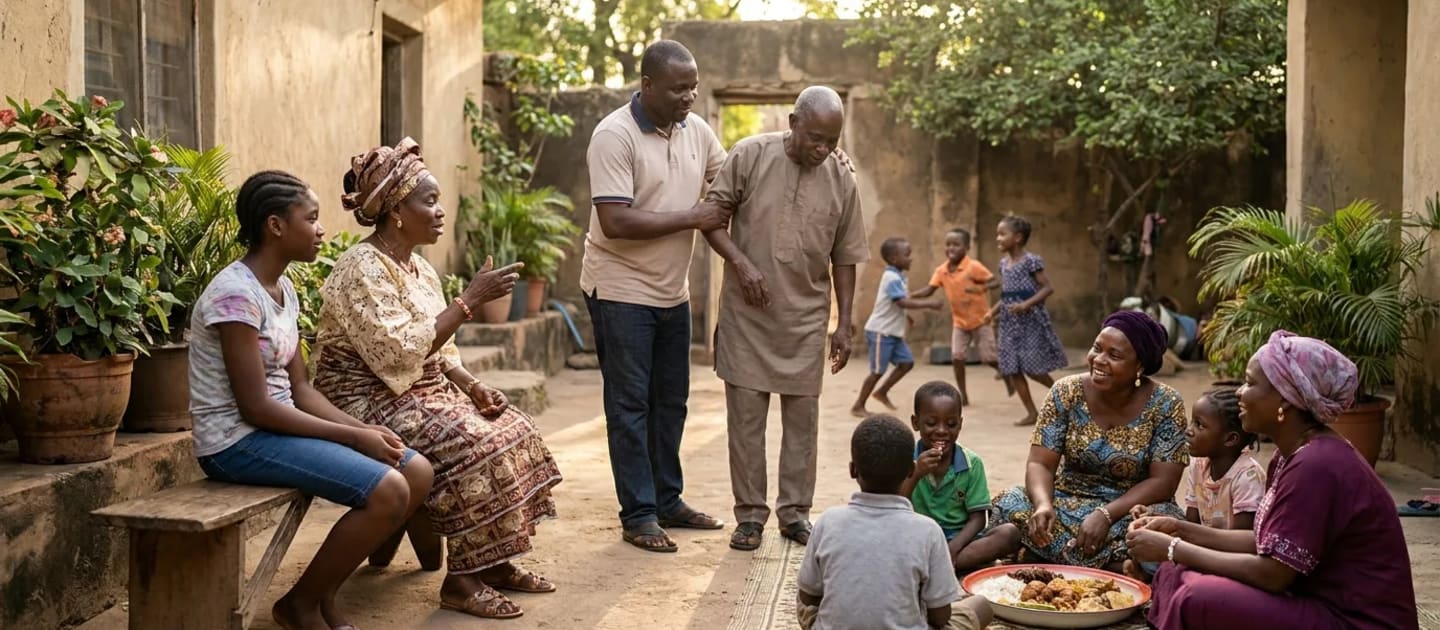
Across Nigeria's many peoples, the basic social unit that people actually live and reckon obligation within is wider than the nuclear household of parents and children familiar in much Western social thought. In many traditional settings — the Yorùbá agboolé (family compound), the Igbo extended household grouped by lineage (umunna) and the equivalent structures found among the Hausa-Fulani, Edo, Ijaw and other groups — several related households, often spanning three or more generations, live in shared or adjoining compounds, hold certain property in common, and are bound together by mutual duties that a nuclear-family model does not capture. A person's identity and social standing rest heavily on their place within this wider lineage, not simply within their immediate household.
Wide kin terms
One visible sign of this is language: in English as spoken by Nigerians, and in most Nigerian languages, the words for "brother" and "sister" routinely cover first cousins, and sometimes more distant relations of the same generation, without any sense of imprecision or exaggeration. Similarly "uncle" and "auntie" are used for a wide range of older relatives and, extended further, as respectful terms for older non-relatives entirely. This is not simply a manner of speech; it reflects and reinforces the underlying expectation that the obligations owed to a full sibling — support, loyalty, a claim on time and money in need — are, to a real if lesser degree, also owed to a first cousin raised in the same compound or the same town.
Remittance and school fees
The most concrete and most discussed expression of extended-family obligation is financial. An adult who is earning, especially one who has left the family's home town or village for education or work in a city or abroad, is typically expected to send money home: to parents, to help pay the school fees of younger siblings, cousins, nieces and nephews, to support elderly or unwell relatives, and to contribute to family projects such as building a house in the home town or funding a relative's wedding, burial or medical treatment. This is not treated as charity in the Western sense of a discretionary gift; it is widely understood as a duty, proportional to one's means, that comes with having succeeded, and failure to meet it can bring real social criticism and strain family relationships.
The eldest and the in-law relationship
Within this structure, the eldest child, and more broadly the eldest surviving member of a lineage or compound, typically carries particular authority and particular responsibility: presiding over family decisions and disputes, representing the family at ceremonies, and often being expected to shoulder the heaviest share of financial obligation to younger relatives, especially after the death of parents. Marriage does not simply join two individuals but two extended families, and the in-law relationship that follows carries its own obligations — visits, gifts, support at ceremonies, and continued deference and courtesy between the families — that can be as significant in daily life as the marriage itself, and that vary considerably in weight and formality between different Nigerian cultures.
Strain under urban migration and cost of living
This system evolved substantially in agrarian, village-based societies with lower living costs and less occupational mobility than exist in Nigeria's cities today. The rise of urban migration for work and education has stretched it in several ways: earners are now often geographically distant from the relatives who depend on them, urban living costs (housing, transport, school fees, healthcare) have risen sharply relative to income, and a single migrant earner in a city or abroad may be expected to support a large and growing number of dependants simultaneously, even as their own household costs climb. This produces genuine and widely discussed strain, felt particularly by younger professionals who describe supporting parents, siblings and extended relatives on salaries that were calculated only for their own needs.
The "black tax" debate
In recent years, Nigerians, alongside people across other African countries facing similar patterns, have increasingly used the term "black tax" — borrowed from South African usage — to describe this pressure, framing it as a burden that falls disproportionately on the first generation in a family to attain a well-paid job or move abroad. The debate is genuinely contested rather than settled. Critics of the term and the framing argue that it recasts a duty of solidarity and reciprocity, one that typically supported the earner during their own upbringing and education, as an unfair imposition, and that the language of "tax" imports an individualist frame poorly suited to how these societies actually understand family. Defenders of the term argue that it gives a name to a real and sometimes crushing financial and emotional burden that can trap young earners in a cycle of supporting others without being able to build their own savings, housing or family, and that naming it is a first step to negotiating healthier boundaries within families. Both positions circulate widely in Nigerian media, social commentary and everyday conversation, and no consensus resolution exists; families continue, in practice, to negotiate the balance between obligation and self-support case by case.
Last verified 13 September 2026
Spotted something wrong? Tell us.