
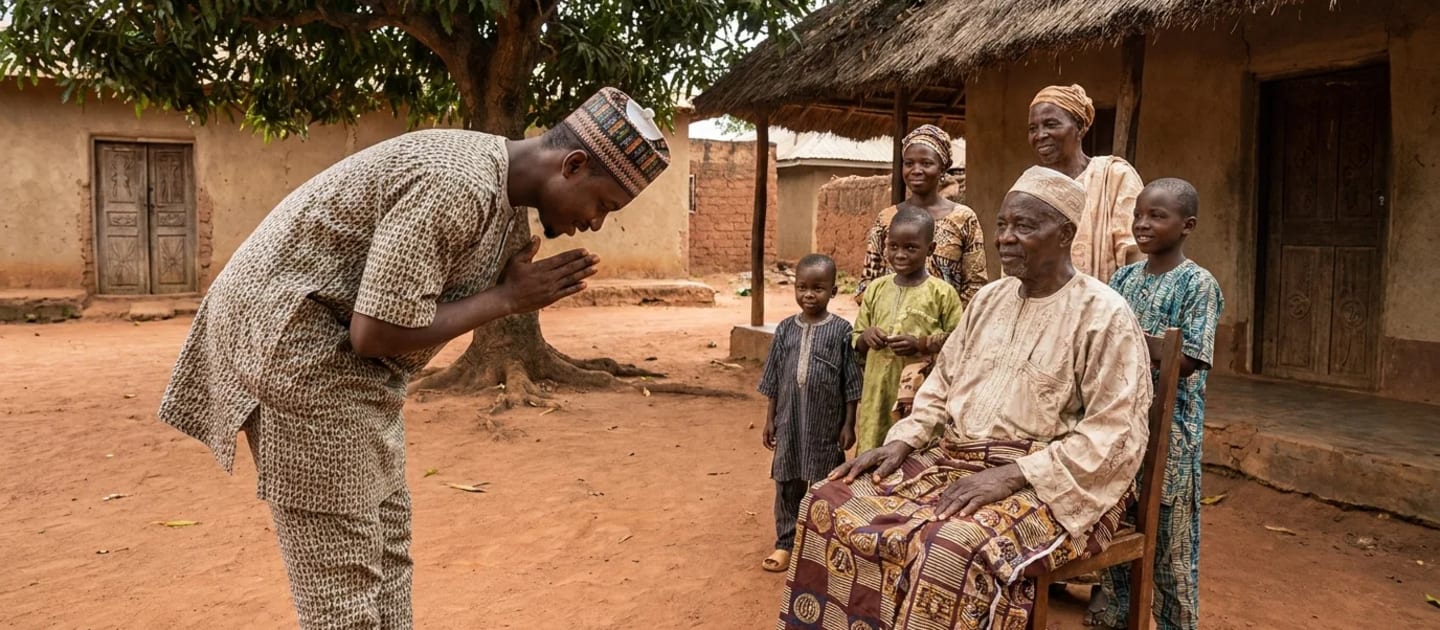
The single most common way a visitor causes offence in Nigeria is by greeting badly: too quickly, from a seated position, with the left hand, or by going straight to business. Greeting is the mechanism by which respect is demonstrated, and skipping it is read as a statement about the other person's worth.
Age is the organising principle. Seniority by even a few years changes how you address someone. Yoruba speakers use the plural e form for anyone older and add a prefix before a name: Egbon for an older sibling or peer, Anti and Uncle for adults of a parent's generation regardless of any blood relation, Mama or Baba for the elderly. Igbo speakers use Nna anyi, Da, Nwanne m and similar terms. In Hausa, Malam, Alhaji and Hajiya carry both respect and religious standing. Calling an older Nigerian by their bare first name, which would be normal in much of Europe or North America, is jarring.
Posture matters. In traditional Yoruba practice a boy or man prostrates, dobale, lying briefly face down or touching the ground, and a girl or woman kneels, kunle, when greeting an elder. Many urban families have relaxed this into a bow or a half-kneel, but the expectation persists at ceremonies and in the presence of parents, in-laws and rulers. In Igbo and Efik communities a slight bow or a handshake with the left hand supporting the right forearm serves the same function. In much of the north, a slight bow with the right hand over the chest is common, and physical contact between unrelated men and women is often avoided, so a man should wait to see whether a woman offers her hand.
The left hand is treated as unclean across most of the country. Giving, receiving, eating and pointing are done with the right. A left-handed person will generally still use the right hand for these acts, and giving something to an elder with the left is a clear insult.
Greetings also take time. Hausa greeting exchanges run through a sequence — ina kwana, how did you sleep; ina gida, how is the household; ina aiki, how is work — each with an expected response, and cutting it short is abrupt. Yoruba has a greeting for nearly every circumstance: e kú iṣẹ́ for someone working, e kú ìrìn àjò for a traveller, e kú ẹ̀wù for someone who has escaped danger, pẹ̀lẹ́ as a general expression of sympathy. Nigerian English carries this over in the ubiquitous well done, said to anyone visibly engaged in a task.
Two other points are worth knowing. Sorry is said to someone who has stumbled or suffered a mishap even when the speaker had nothing to do with it; it means sympathy, not admission of fault. And a younger person is generally expected to greet first. Waiting for an elder to greet you is itself the error.
Last verified 13 September 2026
Spotted something wrong? Tell us.