
Overview
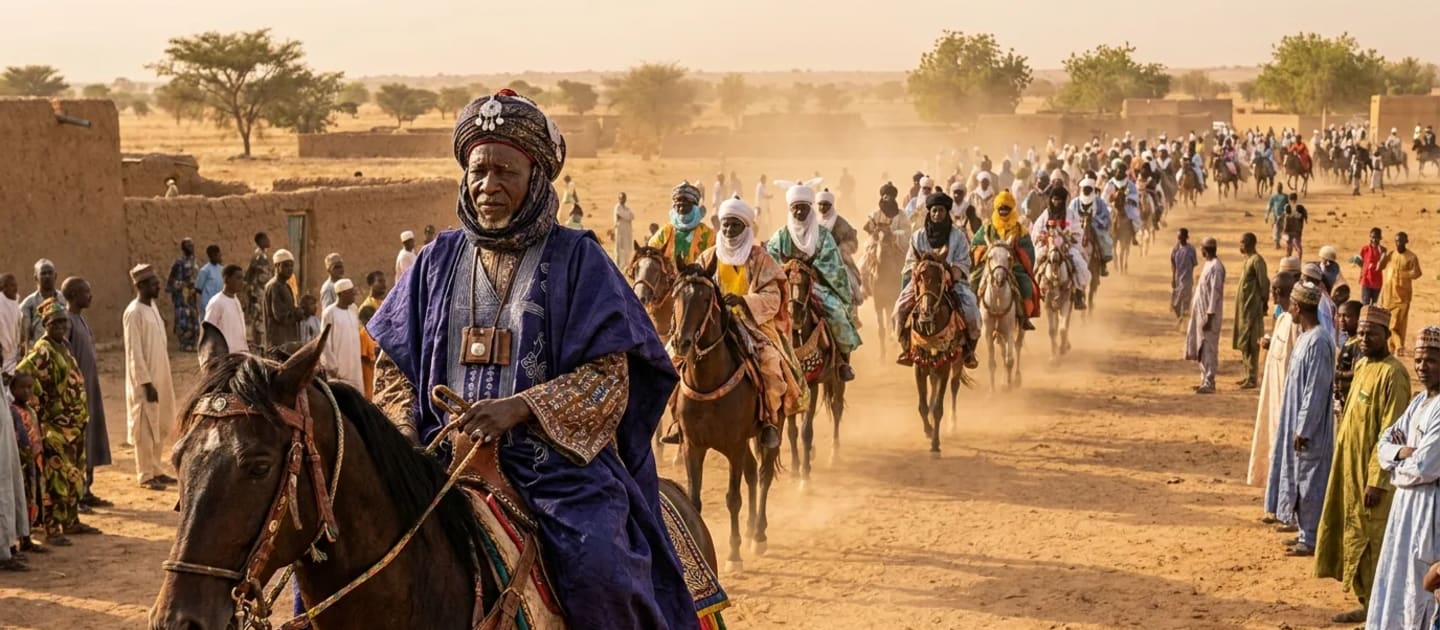
Durbar is the mounted procession held in the northern emirates at the two Eid festivals, in which cavalry in full regalia parade before the emir and salute him at a gallop. Kano, Katsina, Zaria, Bida and Sokoto hold the largest.
History and origin
The tradition descends from the military reviews of the Hausa city states and the Sokoto Caliphate, when each town and noble household was required to contribute cavalry to the emir's defence and would parade to show its readiness. With the end of military function under colonial rule the parade survived as ceremony, and it remains organised around the same household and district units.
What happens
Districts and noble houses arrive in turn, horses caparisoned in quilted armour and embroidered cloth, riders in turbans and gowns, accompanied by kakaki trumpets, drums and praise singers. Each group approaches the emir's dais, then charges towards him at full gallop, reining in sharply a few metres away and raising their swords in the jahi salute. The emir rides out from the palace under a state umbrella. The largest processions run for hours and draw crowds in the hundreds of thousands.
When it takes place
The days following Eid al-Fitr and Eid al-Adha, and occasionally for the installation of an emir.
Where a date is set by a traditional council, a lunar calendar or the harvest, it changes from year to year. Confirm locally before making plans around it.
Where to see it
Kano, Katsina, Zaria, Bida, Sokoto and other emirate capitals, Kano State
The people behind it
HausaThe Hausa are the dominant people of north western Nigeria and of southern Niger Republic, centred on old walled cities such as Kano, Katsina, Zaria, Daura and Gobir. These city states, the Hausa Bakwai of tradition, grew wealthy from trans-Saharan trade in leather, cloth, kola, grain and salt, and from craft industries — the Kano dye pits have been worked for more than five hundred years. Islam arrived through that trade from around the fourteenth century and is now near universal among the Hausa. The Sokoto Caliphate, established after Usman dan Fodio's jihad of 1804, reorganised Hausaland under a single Islamic administration and produced the emirate system that still carries real social weight alongside the modern state. Hausa is the most widely spoken indigenous language in Nigeria and functions as a lingua franca across the Sahel, written both in the Latin boko script and in Arabic-based ajami. Hausa social life places heavy emphasis on greeting at length, on modesty, and on kirki, a word for uprightness that covers honesty, generosity and self-restraint together.Spotted something wrong? Tell us.