
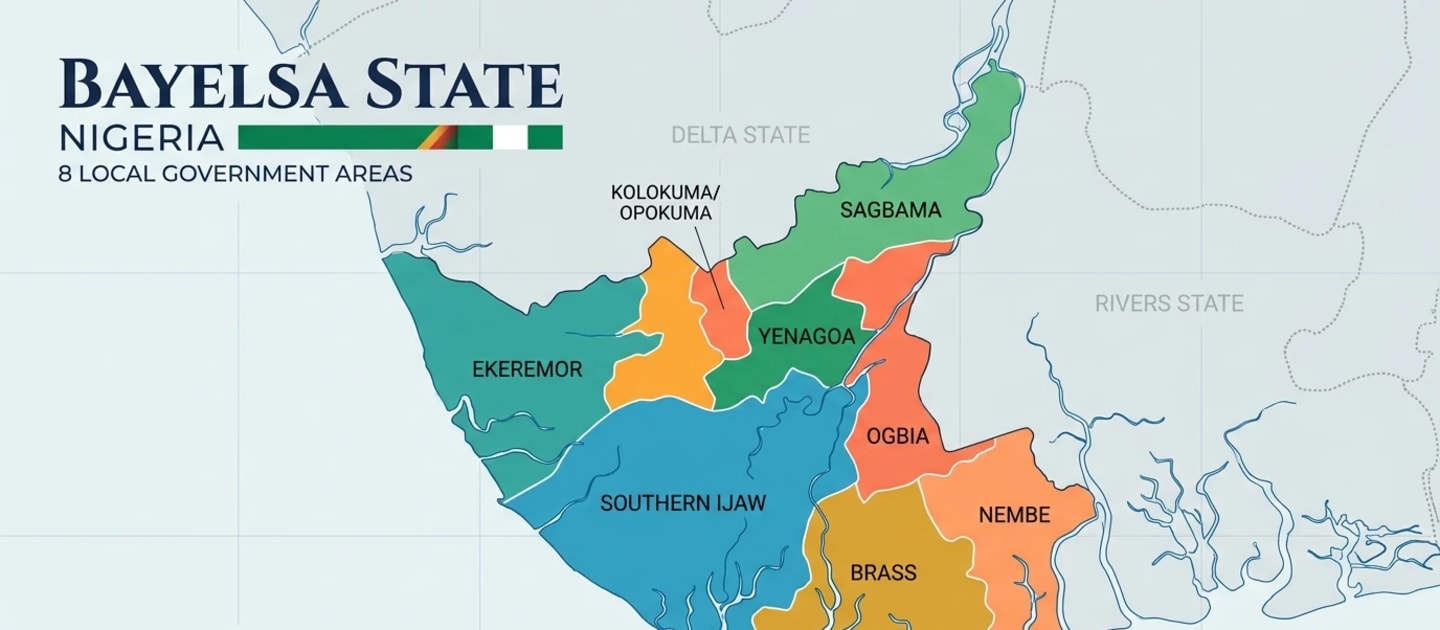
Overview
Bayelsa State, in Nigeria's Niger Delta, was created on 1 October 1996 from the former Rivers State, with Yenagoa as its capital. It is the historic home of the Ijaw people, Nigeria's largest riverine ethnic group, alongside smaller Nembe and Epie-Atissa speaking communities. Bayelsa holds a distinctive place in Nigerian economic history as the site of Oloibiri, where oil was first discovered in commercial quantities in 1956. Despite this legacy, the state remains one of Nigeria's least urbanised, characterised by extensive creeks, swamps and riverine settlements with limited road access. Known as the "Glory of All Lands", Bayelsa's economy and environment are both shaped profoundly by decades of oil and gas extraction in the wider Niger Delta.
History
The Ijaw peoples of the central Niger Delta, including groups around Nembe, Brass and Ogbia, developed trading city-states from at least the 15th century, engaging first in the transatlantic slave trade and later in the palm oil trade with European merchants along the coast and creeks. The Nembe Kingdom in particular resisted British commercial encroachment, notably in the 1895 Akassa raid against the Royal Niger Company. Colonial rule brought the area under Rivers Province in the Eastern Region. In 1956, Shell-BP struck oil in commercial quantities at Oloibiri, in present-day Bayelsa, marking the start of Nigeria's oil industry. The area remained part of Rivers State after 1967 until Bayelsa State was created on 1 October 1996 under General Sani Abacha, with Yenagoa, previously a local government headquarters, named as the new state capital.
Geography
Bayelsa lies almost entirely within the Niger Delta's mangrove and freshwater swamp forest belt, one of the largest wetland systems in Africa, criss-crossed by countless creeks, rivers and tributaries of the Niger, including the Nun and Forcados rivers. Much of the state is low-lying and prone to seasonal and, at times, catastrophic flooding, as seen in major Niger Delta floods in recent decades. Road infrastructure is limited by the terrain, and many communities are accessible mainly by boat. The state's ecology has been significantly affected by decades of oil exploration and production, with gas flaring and oil spills contributing to pollution of waterways, mangroves and farmland in several areas, a longstanding concern for environmental and community advocacy groups.
Economy
Oil and gas dominate Bayelsa's economy, with the state hosting numerous onshore and swamp oil fields operated by international and indigenous companies, and federal oil-derivation revenue forming the bulk of state government income. Fishing is a major livelihood for riverine communities, alongside farming of cassava, plantain and other crops on available dry land. Yenagoa has grown as an administrative and commercial centre since becoming capital, though the state's overall infrastructure, particularly roads and healthcare, lags behind more urbanised parts of the South South. Environmental degradation linked to oil operations has affected traditional fishing and farming livelihoods in several communities, and remediation and compensation for oil pollution remain recurring issues in the state's development discourse.
Next from Bayelsa: read about the Ijaw who live here, or try the food, starting with Fisherman Soup.
Landmarks
Oloibiri Oil Museum
A museum near the site of Nigeria's first commercial oil discovery in 1956, marking the birth of the country's oil industry.
Nembe Kingdom heritage sites
Historic sites associated with the Nembe Ijaw kingdom's trading history and its resistance to colonial commercial encroachment.
Peoples of Bayelsa
- IjawDominant
Izon (Ijaw)
Languages spoken
Ijaw, Nembe, Epie-Atissa
Food from Bayelsa
- Fisherman Soupsoup
A rich seafood soup built on fresh fish, prawns, periwinkle and crab in a peppered broth thickened lightly with palm oil or ground crayfish. Everything goes in with the shells on, so the broth carries the whole catch.
More from South South
Spotted something wrong? Tell us.