
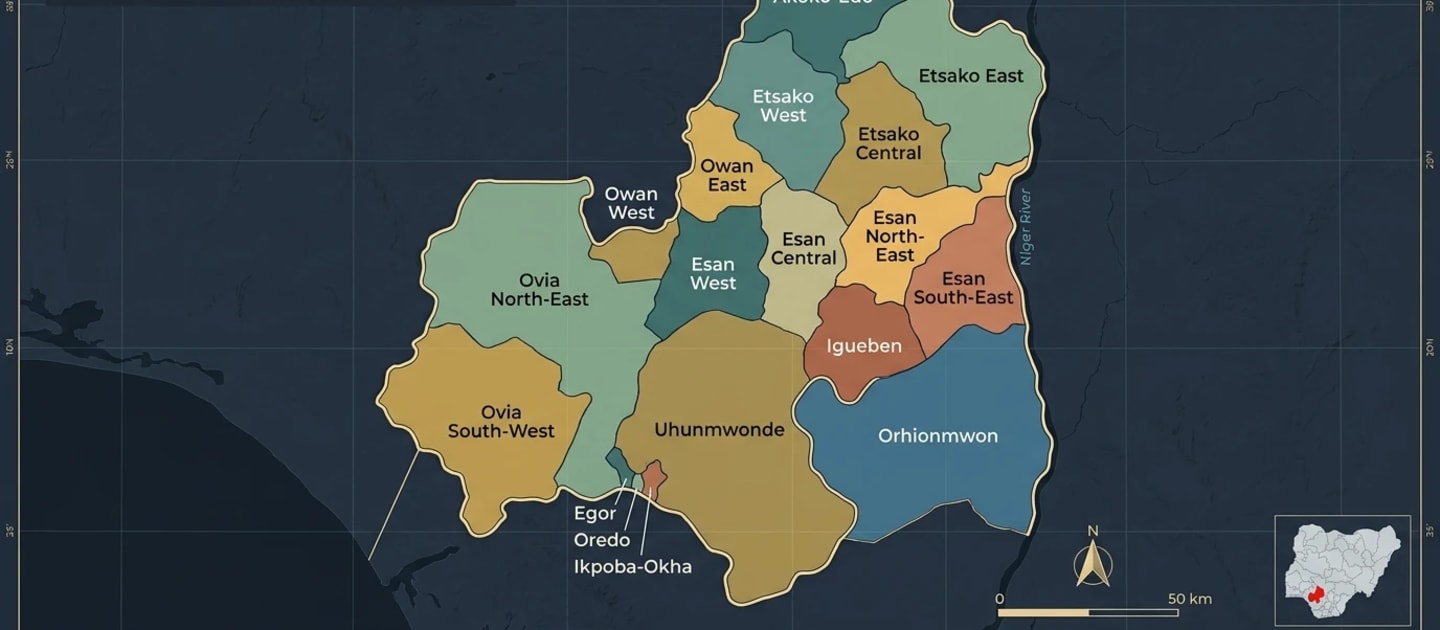
Overview
Edo State, in Nigeria's South South zone, was created on 27 August 1991 from the former Bendel State, with Benin City as its capital. It is the historic seat of the Kingdom of Benin, one of West Africa's most powerful and long-lived pre-colonial states, still headed today by the Oba of Benin as a traditional ruler. Edo is home mainly to the Edo (Bini) people around Benin City, with Esan, Owan and Etsako communities in its northern areas. The state is closely associated internationally with the Benin Bronzes, thousands of brass, bronze and ivory artworks looted by a British force in 1897, many of which remain in foreign museums and collections and are the subject of ongoing repatriation efforts. Edo's economy combines administration, trade and agriculture.
History
The Kingdom of Benin, ruled by the Oba, rose to prominence from around the 13th century and became one of the most sophisticated states in West Africa, renowned for its walls and moats, its guild-organised production of brass and bronze artworks, and its extensive trade, first regionally and later with Portuguese traders from the late 15th century. The kingdom reached its height between the 15th and 17th centuries. In February 1897, a British force launched a punitive expedition against Benin City in retaliation for the killing of a British delegation, destroying much of the city, exiling the Oba, and looting thousands of bronze and ivory artefacts, many of which were later sold to museums and collectors across Europe. The kingdom's territory was absorbed into the Niger Coast Protectorate and subsequently British colonial administration, though the Oba's title was restored under indirect rule. Edo State was created on 27 August 1991 when Bendel State was split along its two dominant linguistic groups, with Benin City retained as capital.
Geography
Edo State lies mostly within the tropical rainforest belt of southern Nigeria, with terrain rising from lowland forest in the south around Benin City towards more undulating and hilly country in its northern reaches around Etsako and Akoko-Edo, where the land approaches the southern edge of the Niger-Benue trough. Rivers including the Ovia, Osse and Ikpoba drain the state, and the far north borders the Niger River near Auchi. Vegetation includes dense rainforest in the south, with derived savanna appearing further north. Rainfall is heavy in the south, tapering somewhat further inland. Edo experiences localised flooding along its river valleys and some erosion in its northern uplands, but is less affected by the extreme creek flooding seen in the coastal Niger Delta states to its south and east.
Economy
Benin City functions as Edo's administrative, commercial and cultural centre, with trade, government employment and services forming major parts of the urban economy. Agriculture is significant across the state, with rubber, oil palm, cocoa and timber long-established cash crops, particularly around Sapele's historic timber and rubber processing and the plantations of the south. Edo also has oil and gas deposits in its southern areas near the Niger Delta fringe. The state has in recent years promoted itself as a hub for job creation and skills programmes, alongside continued efforts, together with the Benin royal court and international institutions, to secure the return of Benin Bronzes held abroad, an issue with cultural and economic significance for the state's heritage tourism ambitions.
Next from Edo: read about the Edo who live here, or follow Igue held late december, in the days leading up to the new year, with exact palace dates fixed by the benin traditional council each year.
Landmarks
Benin City Walls and Moats
Remnants of the extensive earthworks that once encircled the historic Kingdom of Benin, among the largest man-made structures in pre-colonial Africa.
Oba's Palace, Benin City
The traditional palace and seat of the Oba of Benin, centre of Edo royal and cultural life.
National Museum, Benin City
A museum holding artefacts related to the history of the Benin Kingdom, including surviving bronze and ivory works.
Peoples of Edo
Languages spoken
Edo, Esan, Owan, Etsako
Festivals
- Igue
late December, in the days leading up to the New Year, with exact palace dates fixed by the Benin traditional council each year
Culture and custom
More from South South
Spotted something wrong? Tell us.